Learn Hindi online: a complete beginner’s guide
Hindi (हिन्दी) is one of the most widely spoken languages in the world and a major language of daily life in India.
Beginners often feel intimidated by Hindi because of its writing system (Devanagari) and the impression that grammar might be complex.
In reality, Hindi follows a very structured and logical system. Once the script and the core sentence patterns are explained clearly and practiced through real everyday sentences, progress becomes fast and reassuring.
This Loecsen Hindi course is a free online Hindi course for complete beginners. It is designed to help learners understand, read, pronounce, and use Hindi from the very first lessons, using high-frequency expressions exactly as they are spoken in real life.
Core principle (Loecsen):
You do not learn Hindi by memorizing grammar tables or alphabet charts first.
You learn Hindi by listening, repeating, recognizing patterns, and reusing complete sentences.
History and nature of the Hindi language
Hindi belongs to the Indo-Aryan branch of the Indo-European language family. It shares deep historical roots with Sanskrit and is closely related to languages such as Urdu.
Modern spoken Hindi is:
- Non-tonal (no tones like Chinese or Thai)
- Highly phonetic (what you see is usually what you pronounce)
- Pattern-based (grammar relies on stable sentence frames)
For beginners, this means that once you learn how Hindi sounds are written, reading actually helps pronunciation rather than making it harder.
Important: Hindi grammar looks complex in textbooks, but in real everyday usage (A1 level), it relies on a limited number of very frequent patterns.
Where Hindi is spoken and how it fits into India’s linguistic landscape
Hindi is one of the most widely spoken languages in the world, but its role in India is often misunderstood.
To learn Hindi properly, it is essential to understand where it is spoken, by whom, and how it coexists with hundreds of other languages.
Hindi in India: a major language, not the only one
India is not linguistically uniform.
It is one of the most linguistically diverse countries on Earth, with:
- 22 officially recognized languages at the national level
- Hundreds of regional languages and dialects
- Several completely different language families
Hindi belongs to the Indo-Aryan language family, which itself is part of the Indo-European group.
It is spoken primarily in northern and central India, including states such as:
- Uttar Pradesh
- Madhya Pradesh
- Bihar
- Rajasthan
- Haryana
- Delhi
In these regions, Hindi (or closely related varieties) is the native daily language of hundreds of millions of people.
Hindi as a link language across India
Beyond its native regions, Hindi plays a crucial role as a lingua franca.
Many Indians who do not have Hindi as their mother tongue still understand and use it for:
- Interregional communication
- Travel and administration
- Media, cinema, and popular culture
For example, a Tamil speaker from the south or a Bengali speaker from the east may use Hindi to communicate with someone from northern India.
Important:
Hindi is not imposed as a native language everywhere, but it is widely learned as a second language.
Standard Hindi vs. regional varieties
The Hindi taught in courses like Loecsen is Standard Modern Hindi:
- Based on the Delhi region
- Written in the Devanagari script
- Used in education, media, and official contexts
In real life, Hindi exists in many regional and social varieties, influenced by:
- Local languages
- Pronunciation habits
- Levels of formality
This variation does not prevent communication.
Standard Hindi remains widely understood across regions.
Hindi, Urdu, and mutual intelligibility
Spoken Hindi is very close to spoken Urdu.
At the everyday conversational level:
- Grammar is essentially the same
- Basic vocabulary overlaps heavily
- Speakers often understand each other without difficulty
The main differences appear in:
- Writing system (Devanagari for Hindi, Perso-Arabic script for Urdu)
- Formal vocabulary (Sanskrit-based in Hindi, Persian/Arabic-based in Urdu)
For a beginner, learning Hindi gives access to a huge spoken communication area across northern India and parts of Pakistan.
Hindi and the other major Indian languages
India’s other major languages — such as Tamil, Telugu, Bengali, Marathi, Gujarati, Kannada, Malayalam, and Punjabi — are:
- Often not closely related to Hindi
- Sometimes written in completely different scripts
- Still used daily as mother tongues by their communities
This means:
- Learning Hindi does not replace these languages
- But it provides a shared communication base in many situations
For learners:
Hindi is one of the most useful entry points into Indian languages.
It gives immediate communicative reach, even though it is not everyone’s native language.
Why Hindi is an excellent choice for beginners
From a learner’s perspective, Hindi offers several advantages:
- A very large number of speakers
- A clear and phonetic writing system (Devanagari)
- Simple and regular grammar compared to many European languages
- Strong presence in media, films, and daily communication
Learning Hindi does not mean learning “one language among hundreds”.
It means learning a central communication language that opens doors across a vast and culturally rich region.
Bottom line:
Hindi is both a native language for hundreds of millions of people and a shared language for many more.
That dual role is what makes it uniquely powerful for learners.
Understanding the Devanagari writing system clearly
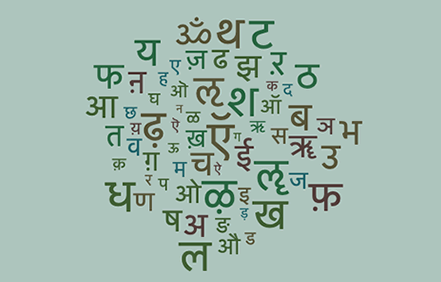
Hindi is written in Devanagari, a phonetic script used for several Indian languages.
Unlike the Latin alphabet, Devanagari is an abugida: each consonant has an inherent vowel sound.
Key idea:
Hindi writing represents sounds, not ideas.
If you can pronounce a Hindi sentence correctly, you can learn to read it step by step.
Sound-first support:
Further down on this page, Loecsen provides a sound-based Hindi alphabet with concrete examples.
Each letter can be seen, heard, and repeated in real words, allowing learners to connect sound, script, and meaning naturally.
What the Hindi script is made of
The Devanagari system consists of:
- Consonants (each with an inherent “a” sound)
- Vowel signs that modify that sound
- Independent vowels (used when a word starts with a vowel)
One of the most reassuring aspects for beginners:
- No silent letters
- No unpredictable spelling
- Very stable sound-to-letter correspondence
The horizontal line (visual anchor)
Most Hindi letters are visually connected by a horizontal line at the top.
This line acts as a visual guide, making words easier to recognize as whole units once you are familiar with the script.
Pedagogical effect: many learners find that once they recognize the “shape” of a Hindi word under the line, reading becomes surprisingly fast.
How Hindi syllables are built (sound by sound)
A Hindi syllable is built around a consonant with an inherent vowel:
Consonant + inherent “a” → default sound
Consonant + vowel sign → modified sound
Let’s use real examples inspired by everyday Loecsen-style Hindi phrases.
Example 1 — “I don’t understand”
मैं नहीं समझता
main nahī̃ samajhtā – I don’t understand.
Breakdown:
- मैं (main) – I
- नहीं (nahī̃) – not
- समझता (samajhtā) – understand
Beginner insight: Hindi negation is extremely stable.
नहीं is placed before the verb — the structure does not change.
Example 2 — “How much is it?”
यह कितने का है?
yah kitne kā hai? – How much is it?
This sentence reuses very frequent building blocks:
- यह (yah) – this
- कितने (kitne) – how much
- का है (kā hai) – is worth / costs
Vowels in Hindi: why they are easier than they look
Hindi vowels exist in two forms:
- Independent vowels (used at the beginning of words)
- Dependent vowel signs (attached to consonants)
Example:
पानी
pānī – water
Once you know the sound of a vowel, its written form is consistent.
There is no guessing involved.
Best beginner strategy: learn vowels through real words you already understand (water, yes, no, here, today), not as abstract symbols.
Hindi pronunciation: what really matters
Hindi pronunciation relies mainly on:
- Clear vowel length (short vs long)
- Aspiration (some consonants are “breathy”)
Unlike tonal languages, pitch does not change meaning in Hindi.
This allows learners to focus on clarity rather than melody.
Loecsen approach: pronunciation is learned by listening and repeating full sentences, not by memorizing phonetic theory.
Hindi grammar: logical and reusable
At beginner level, Hindi grammar is based on stable patterns:
- Subject–Object–Verb order
- Postpositions instead of prepositions
- Very frequent auxiliary verbs
Questions
आप कहाँ से हैं?
āp kahā̃ se hain? – Where are you from?
Key pattern: Hindi questions often keep the same word order and add a question word (कहाँ, क्या, कितने).
Politeness and levels of speech in Hindi (explained clearly)
In Hindi, the word you choose for “you” is never neutral.
It immediately signals respect, familiarity, or intimacy.
This is one of the most important rules for sounding natural in Hindi —
and fortunately, it is very easy to apply at beginner level.
The three forms of “you” in Hindi
-
आप (āp) – polite / respectful “you”
Used with strangers, elders, service staff, colleagues, or in any formal situation.
-
तुम (tum) – neutral / friendly “you”
Used with friends, people of the same age, or in relaxed conversations.
-
तू (tū) – very informal “you”
Used only with very close people or children — can sound rude or aggressive if misused.
Not used by beginners.
Key idea:
Hindi politeness is not optional.
Using the wrong “you” can sound strange or disrespectful, even if the sentence is grammatically correct.
Concrete examples (same meaning, different politeness)
आप कैसे हैं?
āp kaise hain? – How are you? (polite, respectful)
तुम कैसे हो?
tum kaise ho? – How are you? (friendly, neutral)
Both sentences mean “How are you?”, but they are used in different social contexts.
What beginners should actually do
At beginner level, you do not need to master all levels.
You only need one safe rule.
Beginner rule (Loecsen):
Always use आप (āp) with polite verb forms.
This is always correct, always respectful, and never awkward.
Example of a polite sentence used everywhere
धन्यवाद
dhanyavād – Thank you (neutral / polite, universally safe)
Even though धन्यवाद does not contain “you”, it belongs to the same
polite register and fits perfectly with आप-based speech.
Memory shortcut:
If you hesitate → use आप.
If you are unsure → use आप.
If you want to be polite → use आप.
As you progress, exposure to real conversations will naturally help you recognize
when तुम is appropriate — without needing explicit rules.
Learning Hindi through real sentences (Loecsen method)
This course introduces Hindi through complete, high-frequency sentences:
नमस्ते
namaste – Hello
शौचालय कहाँ है?
shauchālay kahā̃ hai? – Where is the restroom?
By repeating these sentences, learners absorb simultaneously:
- Pronunciation
- Script recognition
- Grammar patterns
- Politeness
A practical learning routine with Loecsen
Learning Hindi sustainably relies on simple actions repeated consistently.
- Practice every day, even only 5 minutes.
- Listen first, then repeat aloud.
- Learn full sentences, not isolated words.
- Replay the same phrases until they feel familiar.
- Write short phrases by hand occasionally to anchor the script.
- Reuse known sentences by changing one element.
- Use listening mode for passive exposure.
- Practice with AI dialogues for real-life situations.
- Trust spaced repetition (SRS) and Super Memory.
Staying motivated when learning Hindi
- Lower your daily goal instead of stopping.
- Return to sentences you already understand.
- Listen only on low-energy days.
- Accept approximation as part of learning.
- Focus on understanding before perfect speaking.
Consistency matters more than intensity.
Frequently asked questions about learning Hindi
Is Hindi really difficult?
Hindi looks intimidating because of the script, but it is highly phonetic and grammatically regular at beginner level.
Do I need to master the alphabet before speaking?
No. Start speaking through audio. Reading develops naturally as you recognize repeated words.
How long before I understand basic Hindi?
With regular practice, most learners begin understanding everyday sentences within a few weeks.