
- English
- Français
- Deutsch
- Español
- Português
- Italiano
- Čeština
- Dansk
- Ελληνικά
- Svenska
- Eesti keel
- Suomen kieli
- Hrvatski
- Bahasa Indonesia
- Latviešu valoda
- Lietuvių
- Magyar
- Nederlands
- Norsk
- Polski
- Українську
- Русский
- Türkçe
- Română
- العربية
- Srpski
- 汉语
- 日本語
- 한국어
- हिंदी
- עברית
- български език
- বাংলা
- ภาษาไทย
- Kiswahili
- Bahasa Melayu
- Tagalog
- IsiZulu
- Tiếng Việt
- اردو

Learn Latvian
10%
?


Your program
Your program
First contact
1
Level 1 — The first words
Say the essentials as soon as you arrive
Certificate planned
The first words : greet people and start a conversation
Finish this level to add this skill to your certificate.



2
Level 2 — Finding your way
Understand everyday landmarks
3
Level 3 — Getting by while traveling
Get around without stress
4
Level 4 — At the table and hotel
Order and stay with ease
5
Level 5 — Opening up to others
Connect with people
6
Level 6 — Interactions
Handle the unexpected
Would you like to learn Latvian to understand and use the language in common everyday situations in Latvia? Loecsen offers a structured Latvian course for beginners, designed to reach the skills expected at the CEFR A1 level. Words and sentences are selected to match real usage, following a clear and coherent learning progression. Learning is based on complete sentences, grammar explained through usage, focused pronunciation work, and modern tools to support memorization. With 5 to 15 minutes of practice per day, you can reach your first A1 language goal and gain autonomy from your very first exchanges in Latvian.
View the presentation
Learn Latvian online: a complete guide for real beginners
Latvian may look intimidating at first: unfamiliar letters, long vowels, and a case system. But for beginners, Latvian is also a surprisingly consistent language: spelling is stable, sounds are predictable, and the same patterns come back again and again.
On Loecsen, you learn Latvian with a simple principle: audio first, real phrases, and smart repetition. You train your ear, build reflexes, and understand how the language works through usage — not through abstract rules.
The Loecsen principle:
Meaning comes first.
You first understand when and why a sentence is used.
Then you notice how it is built — and you start recognizing the same patterns everywhere.
Meaning comes first.
You first understand when and why a sentence is used.
Then you notice how it is built — and you start recognizing the same patterns everywhere.
Where is Latvian spoken, and why learn it?
Latvian (latviešu valoda) is the official language of Latvia and is used daily in administration, school life, work, and media. Globally, it is spoken by roughly 1.5 million native speakers (with additional second-language speakers).
Practical point:
Latvian is especially useful if you live in Latvia, work with Latvian partners, or travel outside tourist areas.
Even basic Latvian phrases immediately improve everyday situations: shops, transport, paperwork, and local services.
Latvian is especially useful if you live in Latvia, work with Latvian partners, or travel outside tourist areas.
Even basic Latvian phrases immediately improve everyday situations: shops, transport, paperwork, and local services.
The Latvian writing system: Latin alphabet + diacritics (very learnable)
Good news: Latvian uses the Latin alphabet. The only “new” part is diacritics — marks that change pronunciation. Latvian spelling is generally phonetic: what you see is close to what you say.
The main things beginners must train are:
- vowel length (long vs short vowels),
- special consonant sounds (č, š, ž),
- palatalized consonants (ģ, ķ, ļ, ņ),
- and stress (usually on the first syllable).
Important:
Latvian diacritics are not decoration. They can change meaning and must be learned with audio.
Latvian diacritics are not decoration. They can change meaning and must be learned with audio.
Latvian letters you must learn (with audio)
Latvian uses the Latin alphabet, but it includes several additional letters and diacritics that do not exist in many other languages.
These marks are not decorative: they change pronunciation and sometimes meaning.
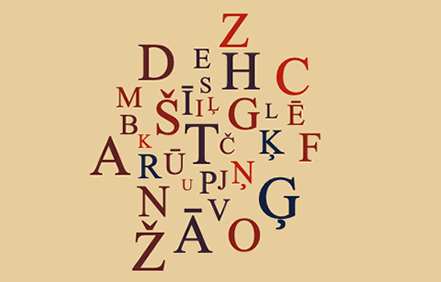
Below are the letters that are “special” in Latvian (long vowels + modified consonants).
Each one is a full letter and should be learned with audio.
-
Ā ā /long ā/
-
Č č /čē/
-
Ē ē /long ē/
-
Ģ ģ /ģē/
-
Ī ī /long ī/
-
Ķ ķ /ķē/
-
Ļ ļ /eļ/
-
Ņ ņ /eņ/
-
Š š /eš/
-
Ū ū /long ū/
-
Ž ž /žē/
Beginner reflex:
Always learn Latvian letters with audio.
Your ear must guide you — especially for long vowels and palatalized consonants.
Always learn Latvian letters with audio.
Your ear must guide you — especially for long vowels and palatalized consonants.
Alphabet with audio: how Loecsen connects letters, sound, and meaning
On Loecsen, you can listen to the Latvian alphabet directly on the page: each letter is linked to its sound, an example word, and a real Loecsen sentence.
This is how you build a direct mental link between writing and pronunciation from day one: you do not “memorize the alphabet” — you connect letters to real speech.
Pronunciation tips: what really matters at the beginning
You do not need a perfect accent to be understood. But three points matter a lot early on:
- Vowel length: ā, ē, ī, ū are long vowels and are distinct sounds.
- Stress: Latvian stress is usually on the first syllable.
- Clear consonants: č/š/ž and ģ/ķ/ļ/ņ must be learned with audio.
Very practical:
If you respect vowel length and first-syllable stress, your Latvian becomes understandable very quickly.
If you respect vowel length and first-syllable stress, your Latvian becomes understandable very quickly.
The Latvian case system: a clear “map” for beginners
Latvian has a 7-case system (for nouns, adjectives, pronouns): the word ending changes depending on the role in the sentence. This can look scary — but the logic is simple:
- Cases replace a lot of “helper words” (like “to”, “of”, “in”).
- Endings repeat constantly, so your brain learns them through exposure.
- In real life, a small number of patterns covers most beginner situations.
Here is the “global map” you want in your head:
- Nominative: who/what (the basic form).
- Genitive: of / belonging / “my, your” type relations.
- Dative: to/for someone (recipient).
- Accusative: direct object (what you want, see, buy…).
- Instrumental: with/by means of (often overlaps with other forms in modern usage).
- Locative: in/on/at (location).
- Vocative: calling someone (names, “hey!”).
How Loecsen makes cases easier:
You hear the same useful phrases again and again in different themes.
Your ear starts recognizing endings before you even try to name them.
You hear the same useful phrases again and again in different themes.
Your ear starts recognizing endings before you even try to name them.
3 beginner grammar rules that make Latvian feel much easier
Loecsen is designed to be practical (real-life phrases, audio, fast reflexes) and also a serious beginner grammar course. You don’t start with abstract rules: you start with sentences you actually use, and we show you the patterns that repeat.
How to use this chapter:
Listen to the phrases, repeat them out loud, then look at the highlighted endings.
Latvian becomes much easier when you notice endings instead of trying to “memorize grammar”.
Listen to the phrases, repeat them out loud, then look at the highlighted endings.
Latvian becomes much easier when you notice endings instead of trying to “memorize grammar”.
Rule 1 — “I / you / we” are clear, and verbs often follow a stable pattern
At beginner level, Latvian gives you a big advantage: the subject is often visible (or obvious), and the verb quickly becomes recognizable. Look at how the same idea repeats:
Es šeit strādāju.
I work here.
I work here.
Mēs šeit strādājam.
We work here.
We work here.
What to notice:
Same meaning, same structure — only the verb ending changes:
strādāju (I) → strādājam (we).
This is exactly how Loecsen builds reflexes: you meet the same patterns in many themes.
Same meaning, same structure — only the verb ending changes:
strādāju (I) → strādājam (we).
This is exactly how Loecsen builds reflexes: you meet the same patterns in many themes.
Rule 2 — One tiny word makes questions polite: “Vai … ?”
Latvian has a very beginner-friendly question marker: vai. If you put vai at the start, you instantly get a yes/no question.
Vai tu dzīvo šeit?
Do you live here?
Do you live here?
Vai Jūs varat paņemt manu bagāžu?
Can you take my luggage?
Can you take my luggage?
Beginner shortcut:
Learn this frame by heart: Vai … ?
You can reuse it everywhere without changing the sentence too much.
Learn this frame by heart: Vai … ?
You can reuse it everywhere without changing the sentence too much.
Rule 3 — Latvian is “ending-based”: word endings carry meaning
In Latvian, endings are not decoration: they tell you who owns something, who is involved, and what role a word plays. Even at A1, you can already see it in family words:
Mans tēvs.
My father.
My father.
Mana māte.
My mother.
My mother.
Mans dēls.
My son.
My son.
Mana meita.
My daughter.
My daughter.
What to notice:
The form of “my” changes with the noun: mans vs mana.
You do not need labels yet — just train your eye to spot these endings.
The form of “my” changes with the noun: mans vs mana.
You do not need labels yet — just train your eye to spot these endings.
Our favorite advice:
Don’t “study Latvian grammar”. Listen to real phrases, repeat them, then notice the endings.
In Latvian, endings are your map — and Loecsen keeps showing you the same map until it becomes obvious.
Don’t “study Latvian grammar”. Listen to real phrases, repeat them, then notice the endings.
In Latvian, endings are your map — and Loecsen keeps showing you the same map until it becomes obvious.
A simple and effective learning routine with Loecsen
Latvian works best with short, regular sessions and repeated exposure to the same sentence structures. Here is a routine that matches the way the brain builds language reflexes:
-
Practice a little every day to build continuity.
5–10 minutes is enough — the goal is frequency, not intensity. -
Listen carefully to the same phrases several times.
In Latvian, repetition is how you absorb vowel length and endings naturally. -
Repeat out loud (even quietly).
Your mouth learns rhythm and clarity — especially the “special letters”. -
Notice recurring endings without trying to label them.
Your brain will build an internal map of cases through examples. -
Write a few short phrases by hand once in a while.
It reinforces letter recognition (ā, ē, ī, ū) and spelling stability. -
Reuse familiar phrases in new contexts.
Example: once you know a structure, swap one word (place, time, object). -
Use “Listen mode” for passive exposure on low-energy days.
Latvian improves a lot through passive listening because the sound system is regular. -
Practice with AI dialogues to simulate real conversations.
Keep it simple: greetings, directions, buying, basic help requests. -
Trust SRS + Super Memory to review at the right time.
This is crucial in Latvian because endings and long vowels become automatic through timed repetition.
Key rule:
Short, frequent listening beats long, irregular study sessions — especially for Latvian.
Short, frequent listening beats long, irregular study sessions — especially for Latvian.
Staying motivated while learning Latvian
With Latvian, progress is often internal before it becomes visible. First you recognize sounds and endings, then you start understanding faster, then speaking becomes easier.
- Trust repetition, even when progress feels slow.
- Accept partial understanding as normal: it means your brain is building patterns.
- Return to familiar phrases to regain confidence.
- On low-energy days, focus on listening — it still moves you forward.
How the Loecsen “First Contact” course supports real beginners
Loecsen provides a structured path to learn Latvian through real usage. Grammar is introduced implicitly through examples, audio, and repetition. With regular practice, learners reach a functional CEFR A1 level — enough to understand and use Latvian in simple everyday situations.
FAQ – the 7 questions people most often ask about Latvian
1) Is Latvian hard to learn?
Latvian is different from Romance languages, but it is very learnable. The main difficulty is the case system — and Loecsen reduces it by teaching cases through repeated real phrases instead of tables.
2) Do I need to learn the special letters and diacritics?
Yes. Long vowels (ā, ē, ī, ū) and modified consonants (č, š, ž, ģ, ķ, ļ, ņ) are meaningful and must be learned with audio.
3) Where is the stress in Latvian words?
In most words, stress is on the first syllable. If you keep first-syllable stress and respect vowel length, you will sound clear quickly.
4) How many cases are there, and do I need to memorize them?
Latvian has seven cases. You do not need to memorize them as a “list” at the beginning — you need repeated exposure to the same useful structures until endings become familiar.
5) Is Latvian similar to Lithuanian or Russian?
Latvian and Lithuanian are related Baltic languages, but they are not mutually intelligible: vocabulary and grammar differ a lot.
Russian is from a different branch (Slavic) and is not “close” to Latvian structurally — even if many people in the region may speak it.
6) Can I get by in Latvia with English?
In Riga and tourist settings, often yes. But for daily life (services, paperwork, local situations), even basic Latvian makes a real difference and changes how people respond to you.
7) What should I focus on first to progress fast?
Audio + repetition + survival phrases. Learn the special letters with sound, then build a core set of everyday sentences (help, directions, buying, basic conversation). This is exactly what Loecsen is designed for.
Why Loecsen works especially well for Latvian
Latvian is a language where patterns repeat constantly (endings, stress, phrase structures). Loecsen takes advantage of this by:
- reusing the same structures across themes,
- anchoring everything in audio,
- and using spaced repetition (SRS + Super Memory) to make forms automatic.
You don’t “study Latvian”. You build Latvian reflexes.
Our favorite advice:
Start with the special letters with audio (ā ē ī ū č š ž ģ ķ ļ ņ).
If your ear understands vowel length early, the whole language becomes easier.
Start with the special letters with audio (ā ē ī ū č š ž ģ ķ ļ ņ).
If your ear understands vowel length early, the whole language becomes easier.
Course syllabus – What you’ll learn
Level 1 — The first words
- Essentials 2-3H • 63-95D • 20-30 sessions
- Conversation 0-0H • 59-89D • 0-0 sessions
- Learning 1-2H • 61-92D • 10-15 sessions
View all levels (6)
Level 2 — Finding your way
- Colours 1-2H • 61-92D • 10-15 sessions
- Numbers 0-0H • 59-89D • 0-0 sessions
- Time tracking 3-5H • 64-96D • 25-38 sessions
Level 3 — Getting by while traveling
- Taxi 0-0H • 59-89D • 0-0 sessions
- Transportation 3-5H • 64-96D • 25-38 sessions
- Beach 0-0H • 59-89D • 0-0 sessions
Level 4 — At the table and hotel
- Restaurant 0-0H • 59-89D • 0-0 sessions
- Bar 0-0H • 59-89D • 0-0 sessions
- Hotel 0-0H • 59-89D • 0-0 sessions
Level 5 — Opening up to others
- Family 0-0H • 59-89D • 0-0 sessions
- Feelings 0-0H • 59-89D • 0-0 sessions
- Parting 0-0H • 59-89D • 0-0 sessions