Learn Estonian online: a free course for complete beginners
Estonian is often described as one of the most complex European languages. This reputation mainly comes from its grammar, which works very differently from most languages learners already know. Yet this same grammar is also what makes Estonian remarkably logical, structured, and consistent.
When approached through real-life expressions, listening, and repetition, Estonian becomes understandable step by step. Instead of memorizing rules, learners gradually grasp how meaning is built inside words themselves.
The Loecsen “First Contact” course is a free online Estonian course designed for people starting from zero. It allows you to begin understanding and using Estonian from the very first lessons, without prior linguistic knowledge.
Where Estonian is spoken and which form you learn
Estonian is the official language of Estonia and is spoken by around one million people. It is used in daily life, education, media, and administration.
This course teaches standard modern Estonian, as spoken today. This form is appropriate for everyday communication, travel, and building a solid foundation to continue learning independently.
The origins of Estonian and its unique linguistic identity
Estonian belongs to the Finno-Ugric language family, alongside Finnish and, more distantly, Hungarian. It is not related to Indo-European languages such as English, French, German, or Spanish.
This explains why Estonian feels so different at first. Its grammar relies on word endings rather than prepositions, and its sentence logic follows its own internal rules.
Over centuries, Estonian developed in close contact with Germanic, Baltic, and Slavic languages. These contacts influenced vocabulary, but the core grammatical system remained Finno-Ugric, making Estonian structurally closer to Finnish than to its geographical neighbors.
Understanding Estonian grammar: thinking in building blocks
Learning Estonian is often compared to building with Lego blocks. Instead of adding many small separate words like “to”, “in”, or “from”, Estonian attaches meaning directly to the end of words.
1. The logic of location (locative cases)
Estonian does not use prepositions placed before the noun such as “in”, “to”, or “from”. Instead, it expresses position and movement by changing the ending of the word. To understand Estonian, it is helpful to think in terms of spatial direction rather than separate words.
Using the word maja (house):
- majas (inessive): indicates position inside a place → in the house
- majja (illative): indicates movement towards the inside → into / to the house
- majast (elative): indicates movement out from the inside → out of / from the house
These three forms express a single underlying idea: where you are in relation to the inside of a place.
2. The “home” example (kodu)
The word kodu (home) is one of the most frequent and useful examples for beginners, because these forms are extremely common in everyday Estonian.
- Ma olen kodus. – I am at home (position)
- Ma lähen koju. – I am going home (movement towards)
- Ma tulen kodust. – I am coming from home (origin)
By repeating sentences like these, learners naturally associate meaning with endings, without needing to memorize grammatical terminology.
What makes Estonian grammar easier than it looks
Despite its reputation, Estonian removes several difficulties common in other languages:
- No grammatical gender: there is no “he” or “she” for objects.
- No articles: there is no equivalent of “a” or “the”.
- No future tense: the present tense combined with time words expresses the future.
For example:
Ma lähen homme tööle. – I go to work tomorrow.
How Estonian sentences work in everyday communication
Estonian sentences often follow a subject – verb – complement structure, which allows beginners to form simple sentences early.
Ma saan aru. – I understand.
Word order can change for emphasis, but meaning remains clear because grammatical roles are carried by word endings, not by position alone.
Verbs, negation, and real-life usage
Everyday Estonian relies on a limited number of very frequent verb forms. Negation follows a clear and consistent pattern:
Ma saan aru. – I understand.
Ma ei saa aru. – I don’t understand.
By learning expressions such as “Ma ei saa aru” (I don’t understand), “Ma tahan minna” (I want to go), or “Ma õpin eesti keelt” (I am learning Estonian), learners quickly cover many everyday situations.
The Estonian alphabet and pronunciation
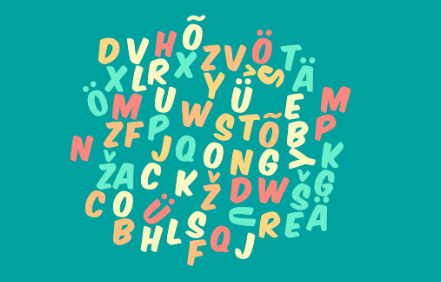
Estonian uses the Latin alphabet, with a few additional letters such as ä, ö, ü, õ. This makes reading visually familiar for many learners.
Pronunciation is generally consistent, but Estonian has an important feature: three degrees of sound length (short, long, and overlong). These differences affect meaning and rhythm.
The best way to learn this is through listening and repetition. Loecsen provides a sound-based alphabet tool further down this page, where each letter is heard, seen in real words, and practiced inside short sentences.
A simple and effective learning routine with Loecsen
Learning Estonian works best with short, regular sessions and repeated exposure to the same structures.
- Practice a little every day to build continuity.
- Listen carefully to the same sentences multiple times.
- Repeat aloud to absorb pronunciation and rhythm.
- Notice recurring word endings without trying to name them.
- Write short sentences by hand to reinforce recognition.
- Reuse familiar expressions in new contexts.
- Use Listening mode for passive exposure.
- Practice with AI dialogues to simulate real conversations.
- Rely on the Spaced Repetition System (SRS) and Super Memory to review expressions at the right moment.
Staying motivated while learning Estonian
Progress in Estonian is often internal before it becomes visible. Recognition comes before fluency.
- Trust repetition, even when progress feels slow.
- Accept partial understanding as a normal stage.
- Return to familiar sentences to regain confidence.
- Focus on listening on low-energy days.
How the Loecsen “First Contact” course supports beginners
The Loecsen “First Contact” course offers a structured path to learning Estonian through real usage.
Grammar is introduced implicitly through examples, audio, and repetition. With regular practice, learners reach a functional CEFR A1 level, allowing them to understand and use Estonian in simple everyday situations.
Frequently asked questions about learning Estonian
Is Estonian really that difficult?
Estonian is different rather than difficult. Once its logic is understood, it becomes predictable and structured.
Can I learn Estonian alone and for free?
Yes. A structured free online Estonian course like Loecsen allows beginners to start independently and progress steadily.
How long does it take to start understanding Estonian?
With regular listening and repetition, many learners begin recognizing structures and meanings within a few weeks.
Do I need to study grammar rules?
No. Estonian grammar is best absorbed through real sentences and repeated exposure.