
Learn Serbian
10%
?
- Hello
- + A more formal expression
- Good evening
- Goodbye
- See you later
- Yes
- No
- Excuse me!
- Thanks
- Thanks a lot
- + A more formal expression
- Thank you for your help
- You’re welcome
- + A more familiar expression
- Okay
- How much is it?
- + A more formal expression
- Sorry!
- + Another way to say
- I don't understand
- I get it
- + When it is a woman who speaks
- I don't know
- Forbidden
- Excuse me, where are the toilets?
- + A more familiar expression
- Happy New Year!
- Happy Birthday!
- Happy Holidays!
- Congratulations!
| English | Serbian | |||
|---|---|---|---|---|
| Hello | Zdravo | |||
| Hello | Dobar dan | |||
| Good evening | Dobro veče | |||
| Goodbye | Doviđenja | |||
| See you later | Vidimo se | |||
| Yes | Da | |||
| No | Ne | |||
| Excuse me! | Izvinite! | |||
| Thanks | Hvala | |||
| Thanks a lot | Hvala puno! | |||
| Thanks a lot | Hvala lepo! | |||
| Thank you for your help | Hvala na pomoći | |||
| You’re welcome | Nema na čemu | |||
| You’re welcome | Molim! | |||
| Okay | U redu | |||
| How much is it? | Koliko košta? | |||
| How much is it? | Pošto je? | |||
| Sorry! | Izvinite | |||
| Sorry! | Oprostite | |||
| I don't understand | Ne razumem | |||
| I get it | Razumeo sam | |||
| I get it | Razumela sam | |||
| I don't know | Ne znam | |||
| Forbidden | Zabranjeno | |||
| Excuse me, where are the toilets? | Molim Vas, gde je toalet ? | |||
| Excuse me, where are the toilets? | Molim Vas, gde je WC? | |||
| Happy New Year! | Srećna Nova godina | |||
| Happy Birthday! | Srećan rođendan | |||
| Happy Holidays! | Srećni praznici! | |||
| Congratulations! | Čestitam! |
View the learning path
All courses
Objectives Do you want to learn Serbian to understand and use the language in common everyday situations in Serbia? Loecsen offers a structured Serbian course for beginners, designed to reach the skills expected at the CEFR A1 level. Vocabulary and sentences are selected to reflect real usage, following a clear and coherent learning progression. Learning is based on complete sentences, grammar explained through usage, focused pronunciation work, and modern tools to support memorization. With 5 to 15 minutes of practice per day, you can reach your first A1 language goal and gain autonomy from your very first exchanges in Serbian.
View the presentation
Learn Serbian online — a complete beginner’s guide (Latin script)
Serbian is a South Slavic language spoken mainly in Serbia, but also widely understood across the Balkans. It is a language with a rich history, strong regional ties, and a structure that is far more regular than it first appears.
On Loecsen, Serbian is taught using the Latin alphabet rather than Cyrillic. This choice is deliberate: for learners who do not already read Slavic or Cyrillic scripts, the Latin writing system allows you to focus on sounds, meaning and usage instead of decoding a new alphabet at the same time.
The Loecsen principle:
Understand spoken Serbian first.
Build reflexes with real phrases.
Let grammar emerge naturally from use.
Understand spoken Serbian first.
Build reflexes with real phrases.
Let grammar emerge naturally from use.
Where Serbian comes from — history and linguistic roots
Serbian belongs to the South Slavic branch of the Slavic language family, alongside Croatian, Bosnian, Montenegrin, Slovenian, Bulgarian and Macedonian. All Slavic languages ultimately descend from Proto-Slavic, spoken more than a thousand years ago.
Historically, Serbian developed at the crossroads of Central Europe, the Balkans and the Byzantine world. This explains:
- its Slavic core vocabulary,
- loanwords from Turkish, Greek and German,
- a strong oral tradition with clear pronunciation rules.
Serbian and Croatian: one language, different standards
For much of the 20th century, Serbian and Croatian were officially grouped under the name Serbo-Croatian. Linguistically, they remain extremely close and mutually intelligible.
The main differences today are:
- Alphabet: Serbian uses both Cyrillic and Latin; Croatian uses Latin only.
- Vocabulary: some everyday words differ.
- Pronunciation: minor regional preferences.
Grammar, sentence structure and most core vocabulary are the same. A learner of Serbian will easily understand Croatian, and vice versa.
Why Loecsen teaches Serbian in Latin script
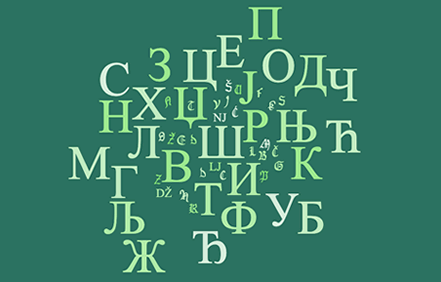
Serbian officially uses two alphabets: Cyrillic and Latin. Both represent the same sounds.
For beginners — especially those who do not speak Russian, Bulgarian or Ukrainian — learning Cyrillic adds an unnecessary cognitive load.
Loecsen’s choice:
Latin script allows learners to focus on pronunciation, listening and speaking first.
Cyrillic can always be learned later, once the language itself feels familiar.
Latin script allows learners to focus on pronunciation, listening and speaking first.
Cyrillic can always be learned later, once the language itself feels familiar.
The Serbian writing system: phonetic and learner-friendly
Serbian Latin is one of the most phonetic writing systems in Europe. A famous principle applies:
Write as you speak. Read as it is written.
Each letter (or letter combination) corresponds to one sound. Once you know the alphabet, reading becomes straightforward.
Serbian letters that must be learned with audio
Serbian Latin uses several letters and digraphs that represent sounds not found in basic English or French. Each one is a full letter and should be learned with audio.
On Loecsen, we teach Serbian in Latin script because it’s the fastest entry point for most learners who don’t already read Cyrillic. The goal is simple: hear → repeat → recognize → reuse in real phrases.
Below are 7 high-impact letters that unlock Serbian pronunciation early. Each card includes: the letter, the sound, and one real Loecsen example with its audio.
Č č
Hard “ch”
Keep it strong and crisp. č is never as soft as ć.
-
Bučan“noisy”
Ć ć
Soft “ch/ty” (lighter than č)
Tongue is closer to the palate: it feels tighter and “softer” than č.
-
Dućan“shop”
Š š
“sh”
Always “sh”, never “s”. Treat it as a full letter with its own sound.
-
Želiš li izaći večeras?“Do you want to go out tonight?”
Ž ž
“zh”
It’s voiced (your throat vibrates). Contrast it with š (unvoiced).
-
Nož“a knife”
Đ đ
Soft “dj” (single sound)
Don’t pronounce it as “d + j”. In Serbian it’s one consonant.
-
Mlađi“younger”
Lj lj
One letter (palatal L, “ly”)
Read it as a single unit. Your tongue touches the palate (not a plain “l”).
-
Biljka“plant”
Nj nj
One letter (palatal N, like Spanish ñ)
Don’t split it into “n + j”. It’s one nasal sound made high in the mouth.
-
Znanje“knowledge”
Important:
These are not letter combinations — they are single sounds. Treat them as one unit from the beginning.
These are not letter combinations — they are single sounds. Treat them as one unit from the beginning.
Mini routine (2 minutes):
Listen once → repeat 3 times → read silently → repeat once again.
Do it daily for a week: your pronunciation will “lock in”.
Listen once → repeat 3 times → read silently → repeat once again.
Do it daily for a week: your pronunciation will “lock in”.
Serbian grammar — understood through use, not rules
Serbian grammar has a reputation for complexity, mainly because of cases. In practice, spoken Serbian relies on highly repetitive patterns. On Loecsen, grammar is absorbed through real phrases.
1. Personal pronouns appear naturally
- ja — I
- ti — you
- on / ona — he / she
- mi — we
Examples heard repeatedly:
- Ja sam ovde (I am here)
- Ti radiš ovde? (Do you work here?)
- Mi smo na odmoru (We are on holiday)
2. Verb “to be” is learned through repetition
The verb biti (to be) appears constantly:
- sam — I am
- si — you are
- je — is
- smo — we are
No conjugation tables — only usage.
3. Questions use stable patterns
- Gde? — where
- Kada? — when
- Kako? — how
- Koliko? — how much
Examples:
- Gde je hotel?
- Koliko košta?
- Kada dolaziš?
4. Cases are absorbed implicitly
Serbian uses cases, but beginners do not need to name them. You simply hear:
- u hotelu
- u gradu
- sa prijateljem
The patterns become familiar long before you study the rules.
How to learn Serbian efficiently as a beginner
- Practice every day, even briefly.
- Always start with audio.
- Repeat phrases aloud to train rhythm.
- Accept partial understanding.
- Trust repetition.
Golden rule:
Consistency beats intensity — especially for Serbian.
Consistency beats intensity — especially for Serbian.
FAQ — Learning Serbian effectively (beginner questions)
Is Serbian hard to learn?
Serbian looks complex on paper, but spoken Serbian is very regular. With audio-based learning, it becomes manageable surprisingly fast.
Do I need to learn Cyrillic?
No. You can communicate perfectly using Latin script. Cyrillic can be added later if needed.
How close is Serbian to Croatian?
They are mutually intelligible. Learning one gives you access to the other.
How long does it take to reach A1?
With regular practice, basic communication is achievable within a few months.
Is pronunciation difficult?
No — Serbian pronunciation is very consistent once you know the sounds.
What is the best way to start?
Start with audio, repeat real phrases, and let grammar emerge naturally.
Our favorite advice:
Learn Serbian with your ears first.
Once the sounds are familiar, everything else becomes easier.
Learn Serbian with your ears first.
Once the sounds are familiar, everything else becomes easier.
Course syllabus – What you’ll learn
- Essentials 2-3H • 63-95D • 20-30 sessions
- Conversation 3-5H • 64-96D • 25-38 sessions
- Learning 1-2H • 61-92D • 10-15 sessions
- Colours 1-2H • 61-92D • 10-15 sessions
View all lessons (17)
- Numbers 4-6H • 67-101D • 40-60 sessions
- Time tracking 3-5H • 64-96D • 25-38 sessions
- Taxi 2-3H • 62-93D • 15-23 sessions
- Family 1-2H • 61-92D • 10-15 sessions
- Feelings 2-3H • 63-95D • 20-30 sessions
- Bar 0-0H • 59-89D • 0-0 sessions
- Restaurant 3-5H • 64-96D • 25-38 sessions
- Parting 2-3H • 62-93D • 15-23 sessions
- Transportation 3-5H • 64-96D • 25-38 sessions
- Hotel 3-5H • 65-98D • 30-45 sessions
- Looking for someone 2-3H • 62-93D • 15-23 sessions
- Beach 3-5H • 65-98D • 30-45 sessions
- In case of trouble 2-3H • 63-95D • 20-30 sessions