Learn Czech online: a free course for complete beginners
Czech often has a reputation for being complex, mainly because of its grammar and unfamiliar sounds. In practice, when approached the right way, Czech is a highly structured and consistent language.
When learned through real-life expressions, spoken examples, and repetition, Czech quickly becomes understandable. Pronunciation follows clear rules, and once sounds are familiar, reading and speaking become much easier.
The Loecsen “First Contact” course is a free online Czech course for beginners, designed for learners starting from zero. It helps you begin understanding and using Czech from the very first lessons.
Where Czech is spoken and which form is taught
Czech is the official language of the Czech Republic and is used in all aspects of daily life, administration, education, and media.
The course teaches standard modern Czech, as spoken today in everyday situations. This form is appropriate for travel, daily communication, and building a solid foundation.
The origins of Czech and its place among Slavic languages
Czech belongs to the West Slavic group of languages, together with Slovak and Polish. It shares historical roots with these languages, which explains many similarities in vocabulary and structure.
Over centuries, Czech developed its own literary tradition and standardized form. It has been influenced by Latin and German, particularly in academic and technical vocabulary, while preserving a strong Slavic core.
This combination gives Czech a clear internal logic, once learners become familiar with its sound system and sentence patterns.
The Czech alphabet: familiar letters, precise sounds
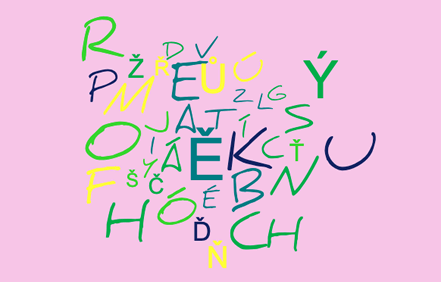
Czech uses the Latin alphabet, which reassures many beginners. However, it also includes diacritics that indicate precise pronunciation.
The modern Czech alphabet consists of 42 letters when letters with diacritics are counted. Each letter corresponds to a specific sound, and there are no silent letters.
Diacritics such as č, š, ž, ř, á, é are not decorative: they signal exact sounds or vowel length. Once learned, they make pronunciation predictable and stable.
How Czech letters and sounds work in practice
The easiest way to understand Czech pronunciation is through real, meaningful words used in everyday situations.
rozumím – I understand
r (r) | o (o) | z (z) | u (u) | m (m) | í (long i) | m (m)
Read together, these sounds form: rozumím
děkuji – thank you
d (d) | ě (ye) | k (k) | u (u) | j (y) | i (i)
Read together, these sounds form: děkuji
prosím – please / you’re welcome
p (p) | r (r) | o (o) | s (s) | í (long i) | m (m)
Each letter is pronounced clearly and consistently. Once the sounds are known, Czech words can be read aloud with confidence, even when encountered for the first time.
How to learn Czech sounds efficiently
Learning Czech pronunciation does not require memorizing isolated rules.
Further down on this page, Loecsen provides a sound-based alphabet tool that allows learners to discover Czech letters and sounds quickly and naturally.
Each letter can be heard, seen, and used inside short example sentences, not just read in isolation.
This makes it possible to learn the Czech alphabet while listening, reading, and repeating at the same time, creating a strong and immediate connection between sound, spelling, and meaning.
Thanks to this approach, learners usually become comfortable with Czech sounds very early, without feeling overwhelmed.
How Czech sentences are built and understood in everyday use
Czech sentence structure is flexible, but in everyday communication it very often follows a clear subject – verb – object pattern. This makes it easier for beginners to start forming correct sentences early on.
For example, a complete sentence looks like this:
Já rozumím. – I understand.
- Já – I (subject)
- rozumím – understand (verb)
Another common example:
Já chci to. – I want this.
- Já – I (subject)
- chci – want (verb)
- to – this (object)
In real spoken Czech, the subject já is very often omitted, because the verb form already indicates who is speaking.
This is why you will usually hear shorter sentences such as:
Rozumím. – I understand.
Chci to. – I want this.
At beginner level, Czech grammar — including grammatical cases — is best learned in this way: inside real, complete sentences. Learners use correct forms naturally by repeating useful expressions, without needing to analyze rules or tables.
By practicing sentences like “I don’t understand”, “I want this”, or “Where is it?”, beginners start using Czech grammar correctly from the start, simply through usage.
This is why, in the Loecsen approach, grammar is always introduced through spoken, everyday sentences, allowing learners to speak first and understand structure progressively.
What to learn first to start speaking Czech
To start speaking Czech, it is far more effective to focus on useful everyday expressions rather than isolated vocabulary.
This helps learners internalize pronunciation, rhythm, and structure at the same time.
A concrete and effective to-do list for learning Czech with Loecsen
Learning Czech sustainably relies on simple, regular actions supported by intelligent repetition.
- Practice every day, even just 5 minutes.
- Learn full sentences instead of memorizing word lists.
- Repeat sentences out loud to absorb sounds and rhythm.
- Listen to the same expressions several times.
- Write short sentences by hand to reinforce memory.
- Reuse known phrases in new situations.
- Use Listening mode for passive exposure.
- Practice with AI dialogues to simulate real conversations.
- Rely on the Spaced Repetition System (SRS) and Super Memory to review expressions at the right moment.
Staying motivated while learning Czech
Feeling uncertain at the beginning is normal, especially when grammar looks unfamiliar.
- Lower your daily goal instead of stopping.
- Return to familiar expressions to regain confidence.
- Switch to listening only on low-energy days.
- Accept approximation as part of learning.
Continuity matters more than intensity in language learning.
How the Loecsen course supports beginners
The Loecsen “First Contact” course is a free online Czech course designed for complete beginners.
It focuses on essential everyday expressions, reinforced through listening, repetition, and contextual explanations.
Thanks to its structured progression and Spaced Repetition System (SRS), learners progressively reach a functional CEFR A1 level.
Frequently asked questions about learning Czech
Is Czech difficult for beginners?
Czech may seem complex at first, but its pronunciation and structure are very consistent once learned through real sentences.
Can I learn Czech online for free?
Yes, by following a structured free online Czech course such as Loecsen.
How long does it take to start understanding Czech?
With regular practice, learners can understand and use basic Czech expressions within a few weeks.