Learn Danish online: a free course for complete beginners
Danish is often described as difficult to understand when spoken, even though it uses the Latin alphabet. This contrast can be surprising for beginners.
In reality, Danish becomes much more accessible when learned through spoken examples, everyday expressions, and repetition. The key is to focus on listening and pronunciation from the start, rather than relying only on written forms.
The Loecsen “First Contact” course is a free online Danish course for beginners, designed for learners starting from zero. It helps you begin understanding and using Danish from the very first lessons.
Where Danish is spoken and which form is taught
Danish is the official language of Denmark and is also spoken in parts of Greenland and the Faroe Islands. It is widely understood across Scandinavia, especially in Norway and Sweden.
The course teaches standard modern Danish, as used in everyday communication today. This form is suitable for travel, daily life, and basic interaction.
The origins of Danish and its place among Scandinavian languages
Danish belongs to the North Germanic group of languages, together with Swedish, Norwegian, Icelandic, and Faroese.
It shares common roots with Swedish and Norwegian, which explains why many words look similar across these languages. However, Danish pronunciation has evolved differently, making spoken Danish more distinct.
Once learners become familiar with Danish sound patterns, understanding other Scandinavian languages often becomes easier as well.
The Danish alphabet and why pronunciation must be learned differently
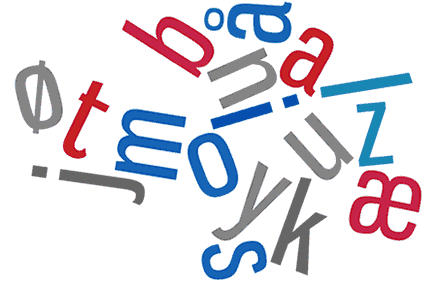
Danish uses the Latin alphabet, which initially reassures many beginners. In addition to the standard letters, Danish includes three specific characters: æ, ø, å, bringing the alphabet to a total of 29 letters. On the surface, Danish words often look easy to read.
In practice, Danish pronunciation does not consistently follow written forms. Many letters change sound depending on their position, and spoken Danish often reduces or softens sounds. This creates a gap between what learners see and what they actually hear.
Some very short words, such as basic confirmations or greetings, are pronounced close to how they are written. However, these words are the exception, not the rule. The real difficulty appears as soon as words become longer or contain specific sound combinations.
Here are a few everyday examples where spelling and pronunciation do not fully align:
forstår – I understand
Approximate reading (English-based): for-STOR
undskyld – excuse me / sorry
Approximate reading (English-based): OON-skul
These examples illustrate why Danish cannot be learned reliably from spelling alone. Written explanations can only give a rough orientation, never an exact pronunciation.
This is why Loecsen places listening at the center of the learning process. Further down on this page, a sound-based alphabet tool allows learners to hear each letter and sound, see them inside real words, and practice them within short everyday sentences.
This combination — visual reference for orientation and audio for accuracy — allows beginners to approach Danish pronunciation realistically, without technical phonetics or misleading simplifications.
How Danish sentences are built and understood in everyday use
Danish sentence structure is generally subject – verb – object, which feels familiar to many learners.
However, Danish uses verb-second (V2) word order in many situations, meaning the verb often comes early in the sentence.
For example:
Jeg forstår. – I understand.
- Jeg – I (subject)
- forstår – understand (verb)
Jeg vil have dette. – I want this.
- Jeg – I (subject)
- vil have – want (verb phrase)
- dette – this (object)
By repeating complete sentences, learners quickly internalize these patterns without having to analyze grammar rules.
Understanding Danish grammar through real usage
Danish grammar is relatively simple compared to many languages.
There are no grammatical cases, and verb conjugation is limited. Most grammatical information is carried by word order and fixed expressions.
By learning phrases such as “I don’t understand”, “I want this”, or “Where is it?”, learners can already manage everyday situations.
In the Loecsen approach, grammar is always learned through complete, spoken sentences, never as abstract theory.
What to learn first to start speaking Danish
To start speaking Danish, it is far more effective to focus on useful everyday expressions rather than isolated vocabulary.
This allows learners to absorb pronunciation, rhythm, and sentence structure at the same time.
A concrete and effective to-do list for learning Danish with Loecsen
Learning Danish sustainably relies on simple, regular actions supported by intelligent repetition.
- Practice every day, even just 5 minutes.
- Listen carefully before speaking to absorb Danish sounds.
- Repeat sentences out loud, even if pronunciation feels strange at first.
- Use the alphabet sound tool to train your ear.
- Learn full sentences instead of word lists.
- Write short sentences by hand to reinforce memory.
- Reuse familiar expressions in new situations.
- Practice with AI dialogues to simulate real conversations.
- Rely on the Spaced Repetition System (SRS) and Super Memory to review expressions at the right moment.
Staying motivated while learning Danish
Feeling confused by pronunciation at the beginning is completely normal.
- Lower your daily goal instead of stopping.
- Focus on listening on difficult days.
- Repeat familiar sentences to build confidence.
- Accept approximation as part of learning.
Continuity matters more than intensity in language learning.
How the Loecsen course supports beginners
The Loecsen “First Contact” course is a free online Danish course designed for complete beginners.
It focuses on essential everyday expressions, reinforced through listening, repetition, and contextual explanations.
Thanks to its structured progression and Spaced Repetition System (SRS), learners progressively reach a functional CEFR A1 level.
Frequently asked questions about learning Danish
Is Danish difficult for beginners?
Danish pronunciation can be challenging at first, but with regular listening it becomes much easier.
Can I learn Danish online for free?
Yes, by following a structured free online Danish course such as Loecsen.
How long does it take to start understanding spoken Danish?
With regular practice, learners can begin understanding basic spoken Danish within a few weeks.