
- English
- Français
- Deutsch
- Español
- Português
- Italiano
- Čeština
- Dansk
- Ελληνικά
- Svenska
- Eesti keel
- Suomen kieli
- Hrvatski
- Bahasa Indonesia
- Latviešu valoda
- Lietuvių
- Magyar
- Nederlands
- Norsk
- Polski
- Українську
- Русский
- Türkçe
- Română
- العربية
- Srpski
- 汉语
- 日本語
- 한국어
- हिंदी
- עברית
- български език
- বাংলা
- ภาษาไทย
- Kiswahili
- Bahasa Melayu
- Tagalog
- IsiZulu
- Tiếng Việt
- اردو
Learn Slovak
10%
?

- Hello
- + Only in the morning
- Good evening
- Goodbye
- See you later
- Yes
- + A more familiar expression
- No
- Excuse me!
- Thanks
- + A more familiar expression
- Thanks a lot
- + A more familiar expression
- Thank you for your help
- You’re welcome
- Okay
- + A more familiar expression
- How much is it?
- Sorry!
- I don't understand
- I get it
- + When it is a woman who speaks
- I don't know
- Forbidden
- Excuse me, where are the toilets?
- Happy New Year!
- Happy Birthday!
- Happy Holidays!
- Congratulations!

| English | Slovak | |||
|---|---|---|---|---|
| Hello | Dobrý deň | |||
| Hello | Dobré ráno | |||
| Good evening | Dobrý večer | |||
| Goodbye | Dovidenia | |||
| See you later | Uvidíme sa neskôr | |||
| Yes | Áno | |||
| Yes | No | |||
| No | Nie | |||
| Excuse me! | Prosím! | |||
| Thanks | Ďakujem | |||
| Thanks | Díky | |||
| Thanks a lot | Ďakujem pekne | |||
| Thanks a lot | Díky! | |||
| Thank you for your help | Ďakujem vám za pomoc | |||
| You’re welcome | Niet za čo | |||
| Okay | V poriadku | |||
| Okay | Platí | |||
| How much is it? | Koľko to stojí, prosím? | |||
| Sorry! | Prepáčte! | |||
| I don't understand | Nerozumiem | |||
| I get it | Rozumel som | |||
| I get it | Rozumela som | |||
| I don't know | Neviem | |||
| Forbidden | Zakázané | |||
| Excuse me, where are the toilets? | Kde sú záchody, prosím? | |||
| Happy New Year! | Šťastný Nový rok! | |||
| Happy Birthday! | Všetko najlepšie k narodeninám! | |||
| Happy Holidays! | Veselé sviatky! | |||
| Congratulations! | Blahoželám! |
View the program
All courses
Objectives Would you like to learn Slovak to communicate more easily in everyday situations in Slovakia? Loecsen offers a structured Slovak course for beginners, designed to reach the skills expected at the CEFR A1 level. Expressions and vocabulary are selected for real situations, following a clear pedagogical progression. Learning is based on complete sentences, grammar explained through usage, careful pronunciation work, and modern tools to support memorization. With 5 to 15 minutes of practice per day, you can reach your first A1 language goal and gain autonomy from your very first exchanges in Slovak.
View the presentation
Learn Slovak online — a complete guide for real beginners
Slovak is a Central European Slavic language with a surprisingly clear spelling system and a sound that becomes familiar fast. If you’ve ever heard Czech, you’ll notice immediate similarities — but Slovak has its own rhythm, vowel length, and a few special consonants that matter from day one.
On Loecsen, Slovak is taught with a simple principle: audio first, real sentences, and progressive repetition. You train the ear, build speaking reflexes, and understand grammar through usage — not through abstract theory.
The Loecsen approach:
You first understand when and why a sentence is used.
Then you naturally notice how it is built.
Grammar becomes obvious because you hear the same patterns again and again.
You first understand when and why a sentence is used.
Then you naturally notice how it is built.
Grammar becomes obvious because you hear the same patterns again and again.
Where Slovak is spoken, and why learning it is worth it
Slovak (slovenčina) is the official language of Slovakia. It is also widely understood in the Czech Republic because the two languages are very closely related.
Learning Slovak is especially useful if you want to travel, study, work, or build local relationships in Slovakia. Even a beginner level changes everyday life: transport, shops, restaurants, accommodation, administration — and simple social contact.
Practical point:
Slovak rewards “small daily practice”. A few minutes with audio, every day, makes the language feel natural surprisingly quickly.
Slovak rewards “small daily practice”. A few minutes with audio, every day, makes the language feel natural surprisingly quickly.
Slovak in context: history, family links, and the Czech connection
Slovak belongs to the West Slavic branch and is commonly grouped with Czech in a Czech–Slovak subgroup. In practice, many linguists describe a strong continuum of similarity between Czech and Slovak, shaped by centuries of proximity and shared modern history.
For learners, this has two consequences:
- Good news: Slovak spelling is consistent and pronunciation is learnable.
- Realistic news: Slovak uses cases (declensions) and rich verb patterns — but they repeat constantly in daily speech.
Slovak writing and pronunciation: what matters first
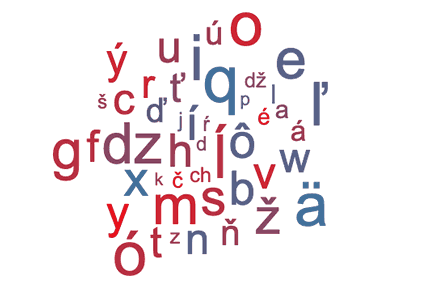
Slovak uses the Latin alphabet with diacritics. For beginners, you do not need to learn everything at once. What matters early is mastering a small set of letters that strongly affect pronunciation and meaning:
- vowel length (á, é, í, ó, ú, ý),
- soft consonants (ď, ť, ň, ľ),
- the digraph ch (a real “letter” sound),
- and the core sibilants (š, ž).
Stress tip:
In Slovak, word stress is typically on the first syllable — a huge help for beginners when speaking smoothly.
In Slovak, word stress is typically on the first syllable — a huge help for beginners when speaking smoothly.
7 Slovak letters and sounds to learn early (with Loecsen audio)
Below are the most useful “high-impact” letters for beginners. Each card includes: the letter sound (Loecsen alphabet audio), a real Loecsen example, and the example audio.
Á
Long “a” — length changes the word and must be heard early.
Think “same vowel, longer time”. Keep it clean and steady.
-
Páči sa mi farba tohto stola“I like the colour of this table.”
Ä
“Fronted” vowel — not the same as plain a.
Say it lighter and more forward in the mouth than a.
-
Čoskoro sa opäť uvidíme“We will see each other soon.”
CH
One sound (not “c+h”) — a strong breathy consonant.
It’s close to the “Bach” sound (German), not English “ch”.
-
chlieb“Bread.”
Ľ
Soft “l” — the tongue is “closer” and more palatal.
Don’t force it: aim for a light, “smiling” l.
-
Ľad“Ice.”
Ŕ
Long syllabic “r” — the “r” can carry a whole syllable.
Keep it steady and voiced; the length matters.
-
Vŕba“Willow.”
Ť
Soft “t” — much lighter than a plain t.
Say it with the tongue closer to the hard palate.
-
Päťdesiat“Fifty.”
Ž
“Zh” sound — like the sound in “vision”.
Keep it voiced and smooth; it’s very common in Slovak.
-
Laž“A lie.”
Beginner reflex:
Don’t “read” Slovak silently at first. Play the audio, repeat out loud, and let your ear build the categories: long vs short vowels, soft vs hard consonants, and the ch sound.
Don’t “read” Slovak silently at first. Play the audio, repeat out loud, and let your ear build the categories: long vs short vowels, soft vs hard consonants, and the ch sound.
Slovak grammar — a practical mini-manual (learned through real Loecsen phrases)
Slovak grammar looks intimidating because of cases, agreement, and rich verb forms. But for a beginner, the fastest path is simple: learn a small set of high-frequency sentence frames, then swap one element at a time. That’s exactly how Loecsen phrases are designed: real situations, repeatable structures, and audio-driven reflexes.
How to use this section:
Each point below gives you a core pattern + Loecsen examples + a quick way to reuse the structure. Don’t “study” it — repeat the audio, then replace one word.
Each point below gives you a core pattern + Loecsen examples + a quick way to reuse the structure. Don’t “study” it — repeat the audio, then replace one word.
1) The Slovak sentence engine: Verb in position 2 (V2), short and stable
In everyday Slovak, sentence rhythm is often built around a simple engine: something + verb + the rest. You don’t need perfect theory — you need a feel for where the verb naturally sits.
-
Som na dovolenke.Word by word: Som = I am · na = on / in · dovolenke = holiday (form meaning “on holiday”).Natural meaning: “I am on holiday.”
-
Je v práci.Word by word: Je = he/she is · v = in / at · práci = work (form meaning “at work”).Natural meaning: “She is at work.”
-
Odchádzam zajtra.Word by word: Odchádzam = I am leaving · zajtra = tomorrow.Natural meaning: “I’m leaving tomorrow.”
Loecsen reflex:
Keep the verb stable, then swap the last part: Som na dovolenke → Som v hoteli → Som v centre.
Keep the verb stable, then swap the last part: Som na dovolenke → Som v hoteli → Som v centre.
2) Questions you will use every day: building meaning with one word
In Slovak, many everyday questions are built around a single key question word. Once you know that word, you can reuse the same sentence frame again and again. This makes questions one of the fastest grammar wins for beginners.
Here are the most useful Slovak question words you meet early in Loecsen, with real everyday meanings.
-
Kde sa môžeme najesť?Word by word: Kde = where · sa = reflexive marker · môžeme = we can · najesť = eat.Natural meaning: “Where can we eat?”
-
Kde je toaleta?Word by word: Kde = where · je = is · toaleta = toilet.Natural meaning: “Where is the toilet?”
-
Ktorý vlak ide do Bratislavy, prosím?Word by word: Ktorý = which · vlak = train · ide = goes · do = to · Bratislavy = Bratislava (destination form) · prosím = please.Natural meaning: “Which train goes to Bratislava, please?”
-
Ktorá ulica je najbližšia?Word by word: Ktorá = which · ulica = street · je = is · najbližšia = nearest.Natural meaning: “Which street is the nearest?”
-
Kedy odchádzame?Word by word: Kedy = when · odchádzame = we are leaving.Natural meaning: “When are we leaving?”
-
Ako sa voláš?Word by word: Ako = how · sa = reflexive marker · voláš = you are called.Natural meaning: “What is your name?”
-
Prečo nie?Word by word: Prečo = why · nie = not / no.Natural meaning: “Why not?”
Loecsen reflex:
Keep the question word, swap the last element.
Kde je…? / Kde sú…?
Ktorý vlak ide do…?
Kedy odchádzame?
One frame, dozens of real questions.
Keep the question word, swap the last element.
Kde je…? / Kde sú…?
Ktorý vlak ide do…?
Kedy odchádzame?
One frame, dozens of real questions.
3) Negation that works everywhere: nie as an answer and as a sentence builder
Negation is one of the most frequent actions in real conversations. Slovak makes it beginner-friendly: a single word, nie, already works as a complete answer — and the same word naturally opens a longer negative sentence.
You do not need complex grammar rules to start saying “no”, “not”, or “nothing”. You build negation step by step, exactly the way it appears in real life.
-
Nie.Word by word: Nie = no / not.Natural meaning: “No.”→ A complete, perfectly natural answer on its own.
-
Nie, nič sme pre vás nedostali.Word by word: Nie = no · nič = nothing · sme = we are / we have · pre vás = for you · nedostali = did not receive.Natural meaning: “No, we didn’t receive anything for you.”
Notice an important Slovak pattern:
- nie answers the question globally (“no”),
- nič reinforces the negation inside the sentence (“nothing”),
- the verb itself is also negative (ne- prefix).
Beginner insight:
Slovak often uses double negation — and that is normal, not “too much”.
You don’t simplify it; you copy it as you hear it.
Slovak often uses double negation — and that is normal, not “too much”.
You don’t simplify it; you copy it as you hear it.
Here are a few more everyday negative frames you will meet very early:
-
Nie som doma.Word by word: Nie = not · som = I am · doma = at home.Natural meaning: “I’m not at home.”
-
Nie je otvorené.Word by word: Nie = not · je = is · otvorené = open.Natural meaning: “It’s not open.”
Loecsen routine:
1) Learn the short answer first: Nie.
2) Then reuse the same word to open a full sentence.
Negation becomes automatic because the structure never changes.
1) Learn the short answer first: Nie.
2) Then reuse the same word to open a full sentence.
Negation becomes automatic because the structure never changes.
4) “I / you / we”: pronouns exist, but the verb already tells you who
In Slovak, personal pronouns do exist, but they are often not required. The verb form already carries the information about who is acting. That’s why many everyday Slovak sentences — including Loecsen phrases — start directly with the verb.
You should therefore learn Slovak pronouns in two steps:
- first, recognize them when you hear or read them,
- then, use them only when needed (emphasis, contrast, clarity).
The core personal pronouns (singular & plural)
- ja — I
- ty — you (singular, informal)
- on — he
- ona — she
- my — we
- vy — you (plural or polite)
- oni — they (masculine / mixed)
Now look at how Slovak really works in practice. The verb form already includes the subject, so the pronoun is often dropped.
-
Som na dovolenke.Word by word: som = am (I am) · na = on · dovolenke = holiday.Natural meaning: “I am on holiday.”
-
Je v práci.Word by word: je = is (he/she is) · v = in · práci = work.Natural meaning: “He / She is at work.”
-
Odchádzam zajtra.Word by word: odchádzam = am leaving (I leave) · zajtra = tomorrow.Natural meaning: “I’m leaving tomorrow.”
You can also add the pronoun — but it usually adds emphasis or contrast, not basic meaning.
-
Ja som tu.Word by word: ja = I · som = am · tu = here.Natural meaning: “I am here.” (emphasis: me, not someone else)
-
My odchádzame.Word by word: my = we · odchádzame = are leaving.Natural meaning: “We are leaving.”
Beginner reflex:
Don’t force pronouns early.
Copy the Loecsen rhythm: verb first, then add place, time, or detail.
Use pronouns only when you want to insist on who.
Don’t force pronouns early.
Copy the Loecsen rhythm: verb first, then add place, time, or detail.
Use pronouns only when you want to insist on who.
5) Cases — learn them as “roles” you can hear (no tables)
Yes, Slovak has cases — but beginners progress faster by learning them as roles: to/for, in/at, from/without, with/by. Loecsen phrases naturally repeat these roles until your ear recognizes them.
IN
Used for places (where someone is / where something happens).
You’ll hear it constantly in daily life: work, hotel, restaurant, city, shop.
-
Je v práci“She is at work.”
-
Som na dovolenke“I am on holiday.”
TO
Used for destinations (where you’re going / what you want to reach).
Perfect for transport and travel phrases — repeat it with new places.
-
Ktorý vlak ide do Slnečného mesta, prosím?“Which train goes to Sun City, please?”
Loecsen trick:
Treat cases as “meaning shortcuts” you can hear. Repeat the same phrase, then swap just the place or object — your brain learns the case automatically.
Treat cases as “meaning shortcuts” you can hear. Repeat the same phrase, then swap just the place or object — your brain learns the case automatically.
6) The “I like…” pattern Slovak actually uses: Páči sa mi…
Slovak often expresses “I like X” with a structure that feels different from English: Páči sa mi + the thing you like. This is exactly the kind of “grammar through usage” that becomes easy with repetition.
- Páči sa mi farba tohto stola. (I like the colour of this table.)
Reuse method:
Keep Páči sa mi fixed, swap the noun: farba → jedlo → hudba → mesto.
Keep Páči sa mi fixed, swap the noun: farba → jedlo → hudba → mesto.
7) Pronunciation is part of grammar: vowel length changes meaning
In Slovak, long vowels are not decoration: they are part of the word. So pronunciation is grammar too. Train your ear with real Loecsen audio: short vs long inside actual sentences.
- Á (long /aː/) appears in: Páči sa mi…
- Í (long /iː/) appears in polite requests: prosím
Golden rule:
In Slovak, clarity comes from vowel length + steady first-syllable stress + calm rhythm. If you repeat with audio, the “grammar” starts sounding obvious.
In Slovak, clarity comes from vowel length + steady first-syllable stress + calm rhythm. If you repeat with audio, the “grammar” starts sounding obvious.
A simple learning routine that works for Slovak
Slovak improves fastest with short, frequent sessions. You don’t need long study blocks — you need repeated contact with the same core phrases.
- 5–10 minutes a day is enough if it’s consistent.
- Listen first, then repeat out loud.
- Replay the same phrase until it feels effortless.
- Swap one element (place, object, time) to generalize the pattern.
- Trust spaced repetition (SRS) to reactivate memory at the right moment.
Motivation tip:
Progress in Slovak is often “invisible” first: sounds become familiar, then words become recognizable, then meaning starts to flow. If you feel stuck, go back to a theme you already know and rebuild confidence.
Progress in Slovak is often “invisible” first: sounds become familiar, then words become recognizable, then meaning starts to flow. If you feel stuck, go back to a theme you already know and rebuild confidence.
Why Loecsen works especially well for Slovak
Slovak has a strong logic: stable spelling, repeating sentence frames, and predictable stress. Loecsen takes advantage of this by anchoring everything in audio, reusing the same structures across themes, and using spaced repetition so forms become automatic.
Our favorite advice:
Start with the 7 “high-impact” sounds above (especially á, ch, ľ, ť). Once your ear is trained, Slovak feels much easier than it looks.
Start with the 7 “high-impact” sounds above (especially á, ch, ľ, ť). Once your ear is trained, Slovak feels much easier than it looks.
Slovak learner FAQ — quick answers to the questions beginners ask most
Q1
It depends on what you compare it to.
Pronunciation and spelling are learnable, but cases and agreement take repetition. The good news: the patterns repeat constantly in real life.
Q2
Six.
You can learn them through usage (“to/for”, “in/at”, “with”) instead of tables at the beginning.
Q3
Usually on the first syllable.
That’s a big advantage: it helps you speak with a steady rhythm without guessing stress each time.
Q4
They’re extremely close, but not identical.
They are often grouped together (Czech–Slovak) and described as a very close continuum; learners will notice differences in vocabulary, pronunciation, and some grammar habits.
Q5
Learn phrases with audio — grammar comes with them.
If you start with real sentence frames, you automatically absorb cases, verb forms, and word order by repetition.
Q6
Vowel length + ch + soft consonants.
If you clearly distinguish short vs long vowels and get ch, ľ, ť right early, your Slovak becomes understandable fast.
Course syllabus – What you’ll learn
- Essentials 2-3H • 63-95D • 20-30 sessions
- Conversation 0-0H • 59-89D • 0-0 sessions
- Learning 1-2H • 61-92D • 10-15 sessions
- Colours 1-2H • 61-92D • 10-15 sessions
View all lessons (17)
- Numbers 0-0H • 59-89D • 0-0 sessions
- Time tracking 3-5H • 64-96D • 25-38 sessions
- Taxi 0-0H • 59-89D • 0-0 sessions
- Family 0-0H • 59-89D • 0-0 sessions
- Feelings 0-0H • 59-89D • 0-0 sessions
- Bar 0-0H • 59-89D • 0-0 sessions
- Restaurant 0-0H • 59-89D • 0-0 sessions
- Parting 0-0H • 59-89D • 0-0 sessions
- Transportation 3-5H • 64-96D • 25-38 sessions
- Hotel 0-0H • 59-89D • 0-0 sessions
- Looking for someone 0-0H • 59-89D • 0-0 sessions
- Beach 0-0H • 59-89D • 0-0 sessions
- In case of trouble 0-0H • 59-89D • 0-0 sessions