
- English
- Français
- Deutsch
- Español
- Português
- Italiano
- Čeština
- Dansk
- Ελληνικά
- Svenska
- Eesti keel
- Suomen kieli
- Hrvatski
- Bahasa Indonesia
- Latviešu valoda
- Lietuvių
- Magyar
- Nederlands
- Norsk
- Polski
- Українську
- Русский
- Türkçe
- Română
- العربية
- Srpski
- 汉语
- 日本語
- 한국어
- हिंदी
- עברית
- български език
- বাংলা
- ภาษาไทย
- Kiswahili
- Bahasa Melayu
- Tagalog
- IsiZulu
- Tiếng Việt
- اردو
Learn Ukrainian
10%
?

- Hello
- + Another way to say
- Good evening
- Goodbye
- + Another way to say
- See you later
- Yes
- No
- Excuse me!
- + Another way to say
- Thanks
- Thanks a lot
- Thank you for your help
- You’re welcome
- + Another way to say
- Okay
- + Another way to say
- How much is it?
- Sorry!
- + Another way to say
- I don't understand
- I get it
- I don't know
- Forbidden
- Excuse me, where are the toilets?
- Happy New Year!
- Happy Birthday!
- Happy Holidays!
- Congratulations!

| English | Ukrainian | |||
|---|---|---|---|---|
| Hello | Добрий день | |||
| Hello | Привіт – Вітаю | |||
| Good evening | Добрий вечір | |||
| Goodbye | До побачення | |||
| Goodbye | Бувай | |||
| See you later | Побачимось | |||
| Yes | Так | |||
| No | Ні | |||
| Excuse me! | Вибачте | |||
| Excuse me! | Перепрошую | |||
| Thanks | Дякую | |||
| Thanks a lot | Дуже дякую! | |||
| Thank you for your help | Дякую за допомогу | |||
| You’re welcome | Будь ласка | |||
| You’re welcome | Прошу | |||
| Okay | Гаразд | |||
| Okay | Добре | |||
| How much is it? | Скільки коштує? | |||
| Sorry! | Пробачте! | |||
| Sorry! | Даруйте! | |||
| I don't understand | Я не розумію | |||
| I get it | Зрозуміло | |||
| I don't know | Я не знаю | |||
| Forbidden | Заборонено | |||
| Excuse me, where are the toilets? | Скажіть, будь ласка, де туалет? | |||
| Happy New Year! | З Новим Роком! | |||
| Happy Birthday! | З Днем народження! | |||
| Happy Holidays! | Зі святом! | |||
| Congratulations! | Вітаю! |
View the program
All courses
Objectives Do you want to learn Ukrainian to understand and use the language in common everyday situations in Ukraine? Loecsen offers a structured Ukrainian course for beginners, designed to reach the skills expected at the CEFR A1 level. Words and sentences are selected to reflect real usage, following a clear and coherent learning progression. Learning is based on complete sentences, grammar explained through usage, focused pronunciation work, and modern tools to support memorization. With 5 to 15 minutes of practice per day, you can reach your first A1 language goal and gain autonomy from your very first exchanges in Ukrainian.
View the presentation
Learn Ukrainian online: a free course for complete beginners
Ukrainian is a major Eastern European language spoken daily by millions of people, primarily in Ukraine and within Ukrainian communities worldwide. For beginners, Ukrainian may seem close to Russian at first glance because both languages use the Cyrillic alphabet. In reality, Ukrainian is a distinct language with its own sounds, vocabulary, grammar, and cultural identity.
The Loecsen Ukrainian course is a free online Ukrainian course for beginners, designed for people starting from zero. It helps learners begin understanding and using modern Ukrainian from the very first lessons, with a clear focus on real communication and contemporary usage.
The origins of Ukrainian: history, language, and identity
Ukrainian belongs to the East Slavic branch of the Indo-European language family, alongside Russian and Belarusian. All three languages descend from Old East Slavic, the language of medieval Kyivan Rus’.
However, Ukrainian evolved along its own path. Over centuries, it developed separately from Russian, influenced by historical, cultural, and political factors, as well as contact with Polish, Lithuanian, and other Central European languages.
For Ukrainians, the Ukrainian language is not just a means of communication. It is a core element of national identity, culture, and history. Using correct Ukrainian forms — and not replacing them with Russian ones — is therefore extremely important and deeply meaningful.
Learning Ukrainian is not “learning a variant of Russian”. It is learning a fully independent language with its own structure, sounds, and expressive patterns.
The Ukrainian alphabet: similar to Russian, but not the same
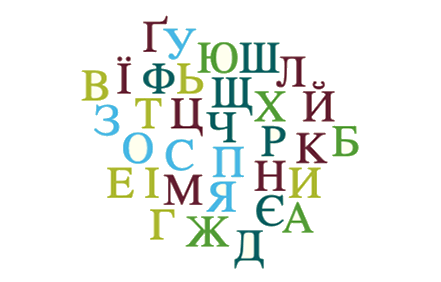
Ukrainian uses a version of the Cyrillic alphabet, composed of 33 letters. At first glance, it looks very similar to Russian Cyrillic, but the two alphabets are not identical. These differences are important to understand early, because they affect pronunciation, comprehension, and meaning.
Some letters exist in Ukrainian but do not exist in Russian. Others are shared by both languages but are pronounced differently. Learning these differences helps avoid confusion and prevents mixing the two languages.
Letters that exist in Ukrainian but not in Russian
Ukrainian includes several letters that are absent from modern Russian:
- І / і – pronounced i (as in “machine”). This sound exists in Russian, but it is written with a different letter (и).
- Ї / ї – pronounced yi. This is a uniquely Ukrainian letter.
- Є / є – pronounced ye at the beginning of words.
- Ґ / ґ – pronounced g (hard “g”, as in “go”). Russian uses г for a different sound.
These letters immediately signal that a text is Ukrainian, not Russian.
Letters used differently in Ukrainian and Russian
Some letters exist in both alphabets but do not represent the same sounds:
- Г / г – in Ukrainian, this letter is usually pronounced like a soft “h”, not like the Russian “g”.
- И / и – in Ukrainian, it represents a sound closer to short “i”, different from Russian и.
Because of these differences, reading Ukrainian with Russian pronunciation immediately sounds incorrect to native speakers.
Letters present in Russian but not used in Ukrainian
Ukrainian does not use several Russian letters, including:
- Ё / ё
- Ы / ы
- Э / э
- Ъ / ъ (hard sign)
This simplifies Ukrainian spelling and pronunciation for learners.
Why Ukrainian Cyrillic is often easier for beginners
Ukrainian spelling is generally very phonetic. Words are pronounced much closer to how they are written than in Russian. There is far less vowel reduction, which makes reading aloud more predictable.
Once learners know the Ukrainian alphabet, they can usually read words aloud reliably, even before understanding their meaning. This removes one of the main psychological barriers when learning a new writing system.
For beginners, this means that learning Ukrainian Cyrillic is not just a technical step, but a real gateway to understanding spoken Ukrainian and using the language confidently.
The Ukrainian alphabet: understanding Cyrillic step by step
The Ukrainian alphabet is based on Cyrillic and contains letters that reflect Ukrainian sounds accurately.
| 1 | А / а | a |
| 2 | Б / б | b |
| 3 | В / в | v |
| 4 | Г / г | h (not g) |
| 5 | Ґ / ґ | g |
| 6 | Д / д | d |
| 7 | Е / е | e |
| 8 | Є / є | ye |
| 9 | Ж / ж | zh |
| 10 | З / з | z |
| 11 | И / и | y (short, central) |
| 12 | І / і | i |
| 13 | Ї / ї | yi |
| 14 | Й / й | y |
| 15 | К / к | k |
| 16 | Л / л | l |
| 17 | М / м | m |
| 18 | Н / н | n |
| 19 | О / о | o |
| 20 | П / п | p |
| 21 | Р / р | r |
| 22 | С / с | s |
| 23 | Т / т | t |
| 24 | У / у | u |
| 25 | Ф / ф | f |
| 26 | Х / х | kh |
| 27 | Ц / ц | ts |
| 28 | Ч / ч | ch |
| 29 | Ш / ш | sh |
| 30 | Щ / щ | shch |
| 31 | Ь / ь | soft sign |
| 32 | Ю / ю | yu |
| 33 | Я / я | ya |
How to learn the Ukrainian alphabet efficiently
Loecsen provides an interactive sound-based Ukrainian alphabet further down on this page. Each letter can be heard, seen, and practiced inside real Ukrainian words and everyday sentences.
This approach helps learners connect reading, listening, and speaking naturally, and avoids confusion with Russian pronunciation.
Understanding Ukrainian grammar through real everyday sentences
Ukrainian and Russian share historical roots, but they are two distinct modern languages. For learners, it is important to understand this difference early, both linguistically and culturally. Ukrainian has its own sounds, its own vocabulary, and its own grammatical preferences, even when sentences look similar on the surface.
In everyday Ukrainian, sentences are often short, clear, and verb-centered, just like in Russian, but the forms used are different. Learning Ukrainian through real spoken sentences helps learners avoid mixing the two languages.
Я розумію. (ya rozumíyu) – I understand.
Я не розумію. (ya ne rozumíyu) – I don’t understand.
Я хочу це. (ya khochú tse) – I want this.
At first glance, these sentences may resemble Russian, but every element is Ukrainian:
- розумію (rozumíyu) instead of Russian понимаю
- це (tse) instead of Russian это
- Different verb roots, even when meaning is the same
One major global difference is pronunciation. Ukrainian pronunciation is much more stable and transparent than Russian. Words are generally pronounced as they are written, with far less vowel reduction.
For example:
- Ukrainian: молоко (molokó) – milk → vowels stay clear
- Russian: молоко (malakó) – vowels are reduced
This makes Ukrainian easier to read aloud for beginners once the alphabet is known.
There are also clear vocabulary differences in very common words:
- дякую – thank you (Ukrainian)
- спасибо – thank you (Russian)
- будь ласка – please / you’re welcome (Ukrainian)
- пожалуйста – please / you’re welcome (Russian)
Grammatically, Ukrainian uses cases like Russian, but endings and preferred structures often differ. Learners do not study these cases as abstract theory at A1 level. Instead, they encounter them naturally inside frequent expressions.
For example:
Я вдома. (ya vdóma) – I am at home.
Я йду додому. (ya ydu dodómu) – I am going home.
Here, the form of the word changes to express location or movement, without adding extra prepositions. This logic is consistent and becomes intuitive through repetition.
Word order in Ukrainian is flexible, but beginners can safely use a subject + verb + object structure and be fully understood. Meaning is carried mainly by verb forms and word endings, not by strict position.
By learning and repeating complete, high-frequency Ukrainian sentences, learners naturally absorb pronunciation, verb patterns, negation, and case usage without consciously memorizing grammar tables.
This approach is essential, because for Ukrainians, using correct Ukrainian forms matters. Mixing Russian vocabulary or structures into Ukrainian is immediately noticeable. Learning Ukrainian through real usage from the start helps learners speak in a way that is both understandable and respectful.
A complete learning method to reach A1 in Ukrainian step by step
The Loecsen Ukrainian course guides learners toward a functional CEFR A1 level, focused on understanding and being understood in everyday situations.
The method combines:
- Short daily practice to build consistency.
- Listening-first exposure to natural Ukrainian.
- Active repetition to anchor pronunciation.
- Progressive tests to strengthen memory.
- Speech recognition for pronunciation practice.
- Spaced repetition (SRS) for long-term retention.
- AI dialogues to practice real situations.
Frequently asked questions about learning Ukrainian
Is Ukrainian the same as Russian?
No. Ukrainian is a distinct language with its own grammar, pronunciation, and vocabulary.
Will Ukrainians understand me if I speak Ukrainian imperfectly?
Yes. Ukrainians generally appreciate any effort to speak their language, especially when learners make the effort to use Ukrainian rather than Russian.
Can I learn Ukrainian online for free?
Yes. Loecsen offers a free online Ukrainian course designed for beginners.
Course syllabus – What you’ll learn
- Essentials 2-3H • 63-95D • 20-30 sessions
- Conversation 0-0H • 59-89D • 0-0 sessions
- Learning 1-2H • 61-92D • 10-15 sessions
- Colours 1-2H • 61-92D • 10-15 sessions
View all lessons (17)
- Numbers 0-0H • 59-89D • 0-0 sessions
- Time tracking 3-5H • 64-96D • 25-38 sessions
- Taxi 0-0H • 59-89D • 0-0 sessions
- Family 0-0H • 59-89D • 0-0 sessions
- Feelings 0-0H • 59-89D • 0-0 sessions
- Bar 0-0H • 59-89D • 0-0 sessions
- Restaurant 0-0H • 59-89D • 0-0 sessions
- Parting 0-0H • 59-89D • 0-0 sessions
- Transportation 3-5H • 64-96D • 25-38 sessions
- Hotel 0-0H • 59-89D • 0-0 sessions
- Looking for someone 0-0H • 59-89D • 0-0 sessions
- Beach 0-0H • 59-89D • 0-0 sessions
- In case of trouble 0-0H • 59-89D • 0-0 sessions